
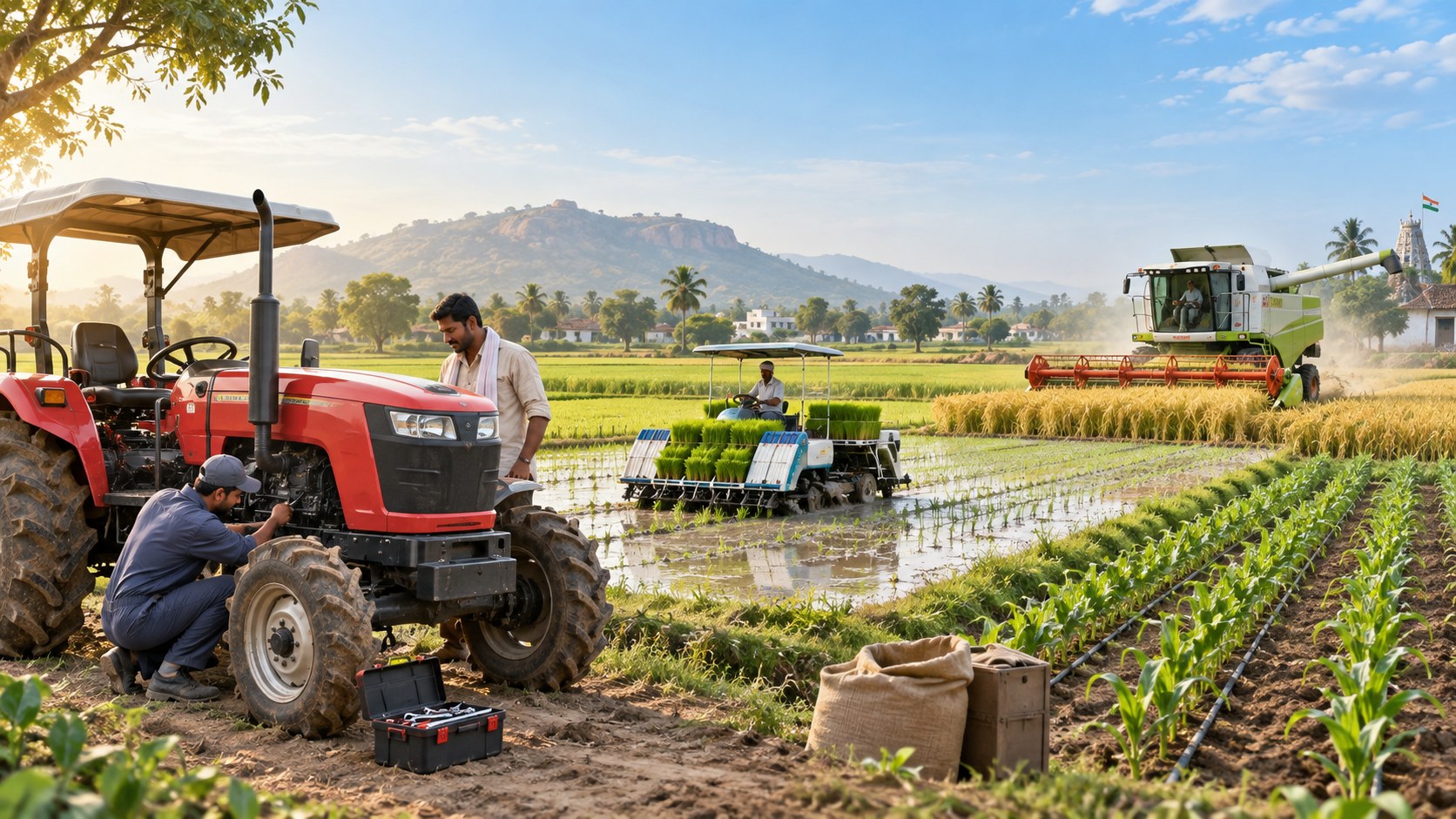
Best Agricultural Machinery for Modern Farming in India: Buying, Renting & Maintenance Guide
Overview
Full Article
Modern agriculture in India is changing rapidly. Farmers, agricultural contractors, landowners, and agribusinesses increasingly depend on efficient machinery to improve productivity, reduce manual labour, save time, and complete farming operations more accurately. From land preparation and planting to harvesting and transportation, choosing the right agricultural machinery can make a major difference to day-to-day farm operations.
However, selecting agricultural equipment is not simply about purchasing the biggest or most powerful machine. The right choice depends on several factors, including farm size, crop type, soil condition, workload, operating environment, budget, maintenance requirements, and how frequently the equipment will be used. In many cases, farmers must also decide whether it is more practical to buy agricultural machinery or rent it when required.
Types of Agricultural Machinery Used in Modern Farming
Agricultural machinery covers a wide range of equipment designed for different farming applications. Some of the most commonly used machines include tractors, combine harvesters, rice transplanters, power tillers, agricultural sprayers, harvesting equipment, and other specialised farm machinery.
Tractors are among the most versatile agricultural machines. Depending on their horsepower and configuration, tractors can support ploughing, cultivation, transportation, sowing, and multiple attachment-based applications.
Combine harvesters help automate important harvesting activities such as cutting, threshing, separation, and grain collection. For farms handling larger cultivation areas, the right harvester can significantly reduce the time and manpower required during the harvesting season.
Rice transplanters are particularly useful in paddy cultivation. They can help farmers maintain more consistent planting patterns and reduce the manual effort associated with transplanting rice seedlings.
Before selecting any machine, customers should compare its specifications, capacity, power, dimensions, application, operating conditions, spare-parts availability, and after-sales support.
Buying vs Renting Agricultural Machinery
Buying agricultural machinery can be suitable when the equipment will be used frequently and the business can justify the long-term investment. Ownership provides greater control over availability and allows the machine to be used whenever required.
However, purchasing machinery also involves an upfront investment along with ongoing expenses for maintenance, repairs, storage, insurance, operators, and replacement parts.
For customers who require machinery occasionally or for seasonal work, agricultural machinery rental may be a practical alternative. Renting can reduce the initial financial burden and provide access to machinery for a particular project, crop cycle, or operational requirement.
Before deciding between buying and renting, consider the expected operating hours, duration of use, available budget, maintenance responsibility, transportation cost, and long-term business requirements.
What to Check Before Buying or Renting
A careful inspection and comparison should be completed before finalising agricultural equipment.
Important points include:
- Machine type and intended agricultural application
- Engine power and performance
- Fuel consumption
- Operating capacity
- Machine age and condition
- Service history, where applicable
- Tyres, tracks, belts, blades, and other wear components
- Availability of spare parts
- Maintenance requirements
- Manufacturer and model specifications
- Purchase or rental price
- Transportation and delivery requirements
- Availability of technical or service support
Customers should also make sure that the machinery is suitable for their specific crop, farm size, terrain, and expected workload.
Agricultural Machinery Maintenance Tips
Regular maintenance is essential for keeping agricultural machinery reliable and reducing unexpected downtime. Farming equipment often operates under demanding conditions involving dust, mud, moisture, heat, crop residue, and long working hours.
Routine maintenance should include inspecting the machine before operation, cleaning accumulated dirt and crop residue, lubricating moving components, checking engine oil and other fluids, inspecting filters, monitoring tyre or track condition, and identifying loose or damaged parts.
Filters should be cleaned or replaced according to the manufacturer's recommended maintenance schedule. Belts, hoses, bearings, blades, chains, electrical connections, and hydraulic systems should also be inspected regularly.
Replacing worn parts at the appropriate time can help prevent more expensive mechanical damage. Proper storage is equally important, particularly when machinery remains unused between farming seasons.
Maintaining service records can also help owners track repairs, replacement parts, and scheduled maintenance.
Reducing Machinery Downtime
Unexpected machine failure during planting or harvesting can affect productivity and delay important farm operations. Preventive maintenance is therefore generally more effective than waiting for a major breakdown.
Operators should report unusual noises, vibration, overheating, warning indicators, fluid leakage, or reduced performance as soon as they appear. Early inspection can help identify problems before they result in significant equipment failure.
Maintaining access to commonly required spare parts and dependable technical support can further reduce operational delays.
Article Summary
Explore the best agricultural machinery for modern farming in India. Learn how to buy or rent tractors, harvesters, rice transplanters and maintain farm equipment.